
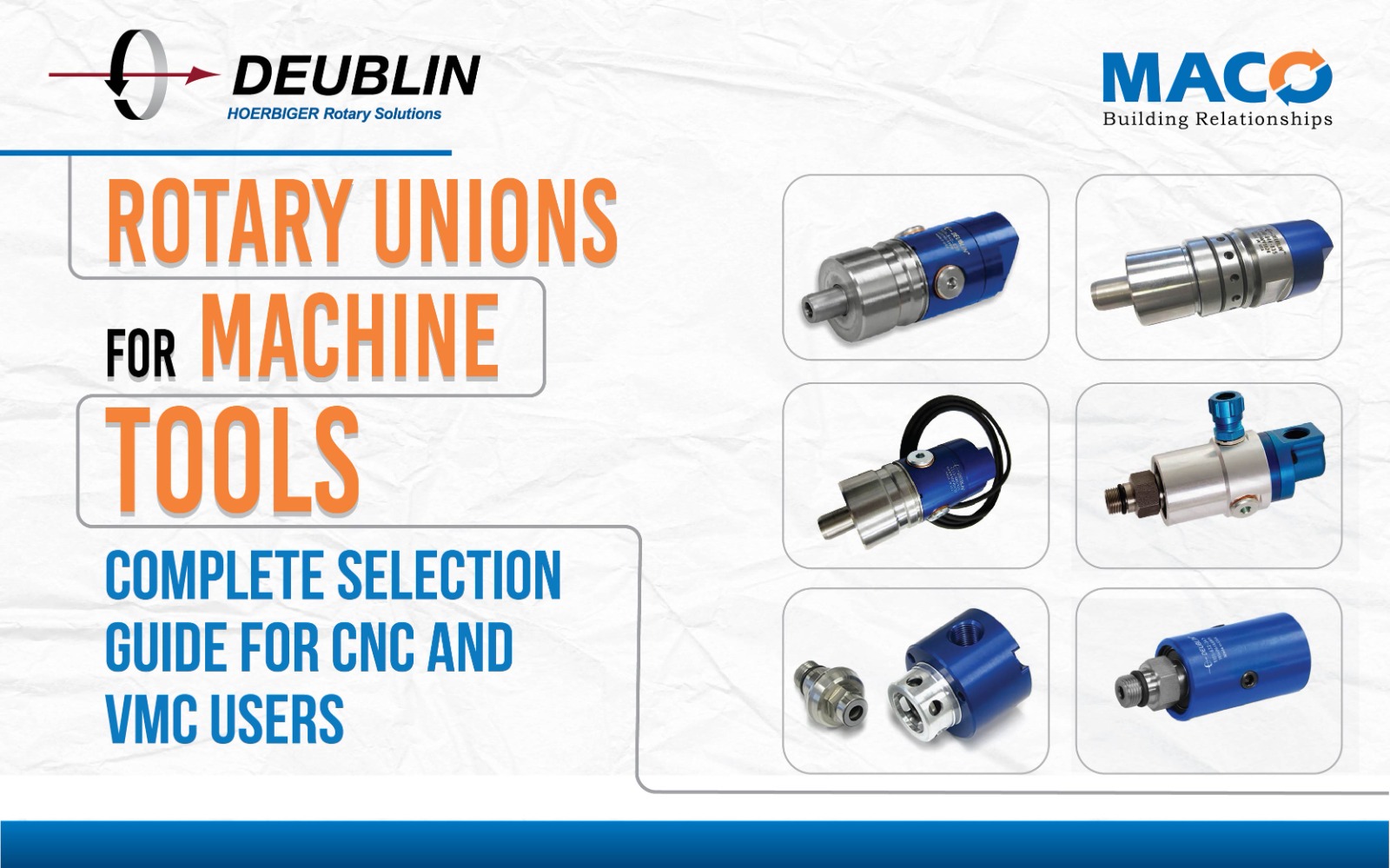
Rotary unions for machine tools (CNC and VMC) are precision devices that transfer coolant, air, hydraulic oil or MQL from a stationary supply to a rotating spindle or rotary table without leakage, allowing high-speed machining with reliable clamping and cooling.
What is a rotary union in CNC and VMC?
A rotary union (also called rotary joint or swivel joint) is a sealing device that connects a stationary coolant or air line to a rotating spindle, rotary table, or fixture. It prevents cross‑contamination and leakage while the spindle or table is rotating at speed under pressure.
In CNC and VMC applications, rotary unions commonly handle:
- Coolant for through‑spindle or through‑tool cooling
- Hydraulic oil for chuck/fixture clamping
- Compressed air for blow‑off and tool changing
- MQL (minimum quantity lubrication) for high‑speed cutting
Modern high‑performance rotary unions use balanced mechanical seals, precision bearings, and hardened housings to maintain sealing at pressures above 100–140 bar and speeds above 20,000–40,000 rpm in advanced machine tools.
Step 1 – Define your application and media
Before choosing a rotary union for CNC machines, define exactly how and where it will be used.
Key questions:
- Which media: coolant, oil, air, hydraulic fluid, or steam?
- Where is it mounted: spindle, rotary table, indexing table, fixture, or ATC system?
- What is the duty cycle: continuous high‑speed machining or intermittent rotation?
Different media impose different demands on the seal and body material:
- Water‑based coolant → risk of corrosion; stainless or coated bodies are preferred.
- Hydraulic oil → requires leak‑tight seals to avoid pressure drop in clamping systems.
- Compressed air / MQL → needs low friction and dry‑running capability at high speeds.
If you have multiple media (e.g., coolant and air for blow‑off), you may need a multi‑passage rotary union with isolated channels.
Step 2 – Match pressure, speed, and temperature
Rotary union selection depends strongly on operating pressure, speed (RPM), and temperature.
Maximum pressure (bar)
- High pressure coolant systems (50–150 bar) demand unions rated above your system maximum with a safety margin.
- Hydraulic clamping often operates between 100–250 bar; ensure the rotary union for hydraulic clamping is specifically designed for these pressures.
Rotational speed (RPM)
- Spindle‑mounted rotary unions for machine tools may run up to 20,000–40,000 rpm.
- Table or fixture unions usually see lower speeds (up to a few thousand rpm) but higher torque from hose drag.
- Always choose a model whose speed rating exceeds your maximum spindle speed with margin.
Temperature (°C)
- Hot oil or high‑temperature coolant increases seal wear; special seal materials may be required.
- Check both continuous and peak temperature ratings.
A practical rule: shortlist only rotary unions for CNC that meet or exceed all three limits simultaneously—pressure, RPM, and temperature—as specified by the machine builder or coolant system provider.
Step 3 – Choose passages and port size
The number of passages and port size has a direct effect on flow, pressure drop, and what functions you can combine.
Single vs multi‑passage
Single‑passage rotary union
- Typical use: through‑spindle coolant rotary union for CNC machines.
- Simpler, more compact, often higher speed rating.
Multi‑passage rotary union
- Use when you need coolant + air, or multiple hydraulic circuits for clamping/unclamping.
- Each passage must be sealed from the others to prevent cross‑leakage.
Port size and type
- Match the inlet/outlet port size to your existing coolant or hydraulic lines.
- Undersized ports increase pressure drop; oversized ports add cost and bulk with no benefit.
- Confirm thread type: NPT, BSP, metric, or flange patterns compatible with your spindle or rotary table.
Step 4 – Select mount type and footprint
The mechanical interface determines installation difficulty and reliability.
Common mounting styles for rotary unions for machine tools:
- Spindle‑mounted unions (nose or rear mount) for through‑spindle coolant and air.
- Through‑bore unions mounted in a rotary table center bore to feed hydraulic fixtures.
- Flange‑mounted unions for indexing tables, clamping systems, and rotary fixtures.
Check:
- Available axial and radial space in the spindle or table.
- Hose routing and whether the body must be fixed or can rotate relative to the hoses.
- Allowance for maintenance access (seal replacement, bearing checks).
A well‑designed rotary union for VMC rotary tables should minimize overhang and vibration, while still providing the required passages and port size.
Step 5 – Select seal, bearing, and body materials
Performance and service life of rotary joints for CNC are heavily influenced by materials.
Seals
- Mechanical seal faces (carbide, ceramic, carbon) for high pressure and high speed coolant.
- Elastomer seals (NBR, FKM, EPDM) for general purpose oil, air, and water.
- Dry‑running capable seals for air and MQL at high spindle speeds.
Bearings
- Precision ball bearings or angular contact bearings for high‑speed spindle unions.
- Robust bearings for slow‑speed, high‑torque table or fixture unions.
Bodies and rotors
- Stainless steel or hardened steel bodies reduce corrosion in coolant and extend life.
- Brass or coated housings can be used for lower corrosion risk applications.
For long‑term reliability, choose a rotary union manufacturer with proven performance data and seal life in similar machine tools and coolants.
Step 6 – Consider maintenance, downtime, and supplier support
The real cost of a rotary union failure is unplanned downtime and scrap, not just the component price.
Evaluate:
- Recommended service intervals and typical seal life for your media and speed.
- Availability of spare seal kits and local support.
- Whether the design allows easy seal replacement without removing the entire spindle or table.
Application‑specific support is critical: suppliers who understand machine tools, CNC, and VMC environments can recommend the right rotary union for coolant or hydraulic clamping instead of generic industrial unions.
Why choose Maco Corporation Pvt Ltd for rotary unions?
For Indian CNC and VMC users, partnering with a reliable, technically strong supplier is as important as choosing the right specification.
Maco Corporation Pvt Ltd is widely recognized as a trusted industrial solution provider and has published technical resources on rotary unions and seal material selection, highlighting the importance of matching seal chemistry and operating conditions to real‑world applications. With experience across steel, automotive, and general manufacturing plants, Maco can help you size and select the most suitable rotary union for machine tools, not just sell a catalog item.
Working with Maco Corporation Pvt Ltd gives you:
- Access to proven rotary union designs suitable for Indian machining conditions and coolants.
- Engineering guidance on pressure, RPM, and seal material choices.
- Local support for troubleshooting leakage, vibration, and premature seal failures.
If you are upgrading to high‑pressure coolant, adding hydraulic clamping to your VMC rotary table, or replacing worn rotary joints on existing spindles, contact Maco Corporation Pvt Ltd today. Their engineering team can review your machine specs and recommend a rotary union for CNC machines that delivers maximum uptime, safe sealing, and long service life.
FAQS
1. What does a rotary union do on a CNC machine?
A rotary union on a CNC machine transfers coolant, air, or hydraulic oil from a stationary supply into a rotating spindle, rotary table, or fixture without leakage. It allows through‑spindle coolant, hydraulic chuck clamping, and air blast to operate safely even at high RPM and pressure.
2. How do I choose the right coolant rotary union for my VMC?
To choose a coolant rotary union for VMC, first note your coolant type, maximum pressure, spindle speed, and available space on the spindle or table. Then select a union rated above those limits, with compatible ports and seal materials, or consult an expert supplier like Maco Corporation Pvt Ltd for sizing support.
3. Why is my rotary union leaking coolant or oil?
A leaking rotary union is usually caused by worn seals, contamination, misalignment, over‑pressure, or running beyond the speed/temperature rating. Regular maintenance, clean media, and correct selection for pressure and RPM significantly reduce leakage and extend service life.
4. Can one rotary union handle both coolant and air on my machine?
Yes, a multi‑passage rotary union can handle both coolant and air on the same machine, provided each passage is isolated and rated for its media. You must specify the number of passages, their media, and pressure/speed conditions so the supplier can recommend the correct multi‑channel design.
5. How often should I replace seals in a CNC rotary union?
Seal life in a CNC rotary union depends on speed, pressure, temperature, media cleanliness, and duty cycle, so there is no single fixed interval. Many machine tool users inspect or replace seals during scheduled spindle or table overhauls, and rely on supplier guidance for expected life under their specific operating conditions.