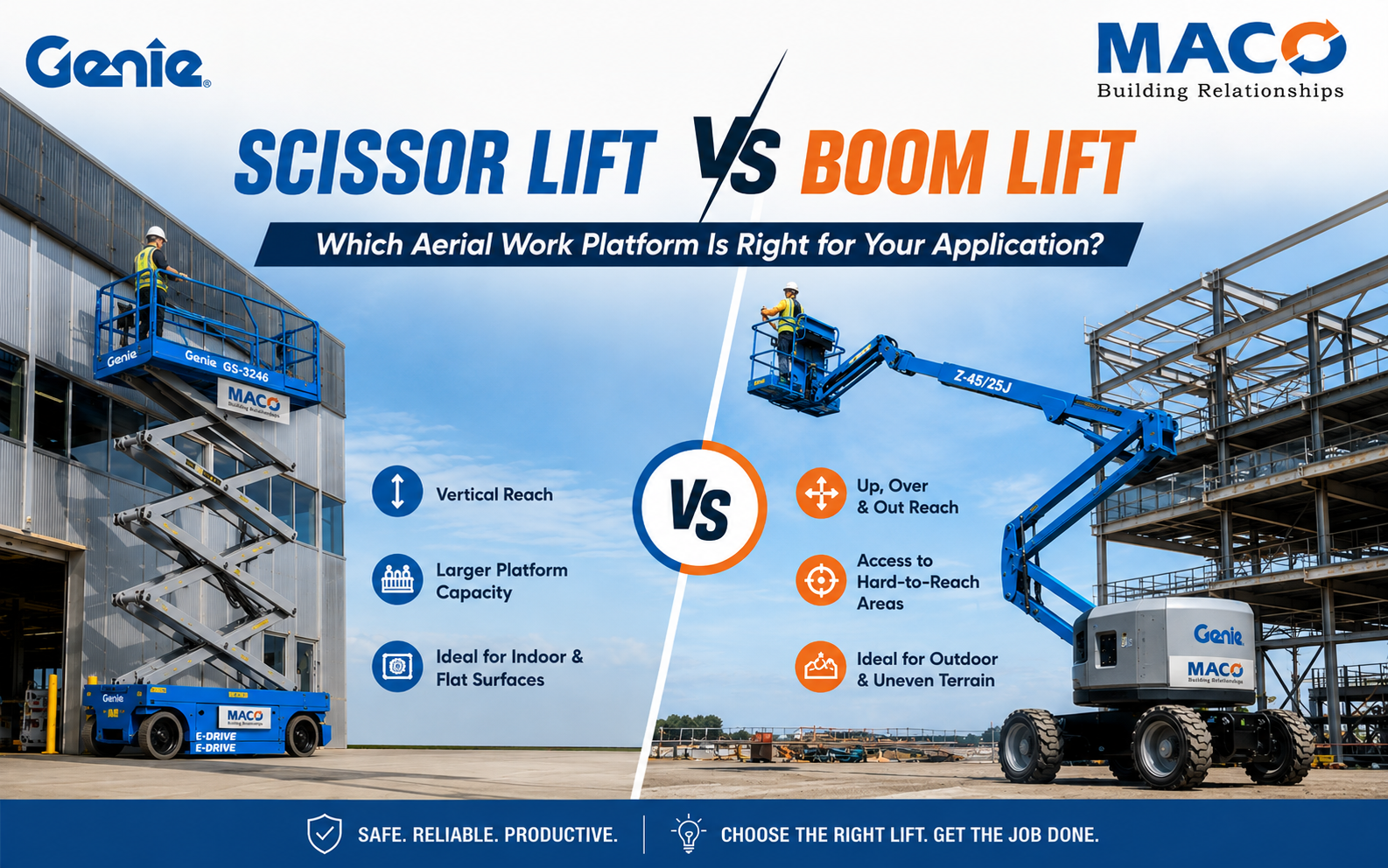
Choosing the right aerial work platform (AWP) can directly affect productivity, access, operating cost, and job-site safety. Two of the most widely used Mobile Elevating Work Platforms (MEWPs) are scissor lifts and boom lifts.
The key difference is simple: scissor lifts primarily provide vertical access, while boom lifts provide vertical and horizontal reach. However, the right choice depends on more than working height. You also need to consider platform capacity, outreach, terrain, indoor or outdoor operation, access restrictions, and the nature of the task. IPAF’s MEWP selection guidance similarly recommends evaluating height and outreach, task, environment, terrain, access, and training before selecting equipment.
Scissor Lift vs Boom Lift: Quick Comparison
| Feature | Scissor Lift | Boom Lift |
| Primary movement | Vertical | Vertical + horizontal |
| Horizontal outreach | Limited/none | Available |
| Platform size | Generally larger | Generally smaller |
| Best for | Work directly above the machine | Work requiring reach around/over obstacles |
| Common applications | Warehouses, maintenance, installation | Construction, infrastructure, industrial access |
| Indoor use | Excellent with suitable electric models | Suitable with appropriate models |
| Outdoor/rough terrain | Rough-terrain models available | Many models designed for outdoor terrain |
Quick answer: Choose a scissor lift when the work is primarily directly above the machine and you need a larger platform. Choose a boom lift when you need to reach up, out, or over an obstacle.
What Is a Scissor Lift?
A scissor lift is a type of MEWP that raises a platform vertically using linked, folding supports. Because the platform remains largely over the machine’s base, scissor lifts are particularly useful when the equipment can be positioned directly beneath the work area.
Common scissor lift applications include:
- Warehouse and facility maintenance
- Ceiling and lighting installation
- HVAC and electrical work
- Construction and finishing work
- Industrial plant maintenance
- Racking and inventory access
- Painting and installation
Electric scissor lifts are commonly suited to indoor environments with firm, level surfaces, while rough-terrain scissor lifts are designed for more demanding outdoor applications.
Key Scissor Lift Specifications
When selecting a scissor lift, look beyond the maximum height. Check:
- Working height
- Platform height
- Platform capacity
- Platform dimensions
- Machine width
- Machine weight
- Gradeability
- Ground clearance
- Power source
- Indoor/outdoor suitability
Important: Working height and platform height are not the same measurement. Working height generally accounts for the operator’s reach above the platform, so buyers should always compare manufacturer specifications rather than relying only on the machine’s model name or platform height.
What Is a Boom Lift?
A boom lift, also called a boom-type aerial work platform, uses an extendable arm to position a platform or basket at height.
Unlike a scissor lift, a boom lift can provide horizontal outreach, allowing operators to access locations that are not directly above the machine.
Boom lifts are commonly used for:
- Building construction
- Structural and steel work
- Facade maintenance
- Roofing
- Industrial maintenance
- Infrastructure projects
- Utilities
- Painting and inspection
- Work around machinery or structures
Articulated Boom Lift vs Telescopic Boom Lift
There are two major boom lift categories.
Articulated boom lifts use multiple hinged sections. They are particularly useful when the operator needs to move up and over obstacles such as roofs, machinery, structures, or other obstructions.
Telescopic boom lifts, also known as straight boom lifts, extend more directly outward and upward. They are useful when long horizontal outreach and high working height are the primary requirements.
The choice should therefore be based on the required working envelope, not simply the maximum advertised height.
Scissor Lift vs Boom Lift: Which Is Better?
There is no universally “better” machine. The right aerial lift depends on the application.
Choose a Scissor Lift When:
- The work is directly above the machine
- You need a larger working platform
- Multiple workers need to work together
- Tools and materials need to be carried
- The surface is suitable for the machine
- You are performing repetitive work along a similar height
- Indoor, low-noise or zero-emission operation is important
Choose a Boom Lift When:
- You need horizontal outreach
- The work area is offset from the machine
- You need to work over an obstacle
- The job requires precise positioning
- The work is at significant height or distance
- The site has complex access requirements
For example, ceiling installation across a large warehouse may favor a scissor lift, while facade work where the machine cannot be positioned directly beneath the work area may require a boom lift. Current industry guidance and comparison content consistently emphasize this vertical-access versus outreach distinction.
Scissor Lift vs Boom Lift by Application
| Application | Suitable MEWP |
| Warehouse ceiling maintenance | Electric scissor lift |
| Indoor lighting installation | Electric scissor lift |
| Large-area overhead installation | Scissor lift |
| Building facade work | Boom lift |
| Work over an obstruction | Articulated boom lift |
| High straight-line access | Telescopic boom lift |
| Industrial maintenance | Scissor or boom lift, depending on access |
| Rough outdoor construction | Rough-terrain scissor or boom lift |
| Steel and structural work | Boom lift |
| HVAC installation | Scissor or boom lift, depending on reach |
The application should always be assessed individually. A site assessment should consider the task, required height and outreach, terrain, access, environment, and the combined weight of operators, tools and materials.
7 Factors to Consider Before Choosing a MEWP
Before purchasing or renting a scissor lift or boom lift, ask these questions:
1. What working height do you need?
Determine the actual height of the work, then select a machine with an appropriate working-height specification.
2. Do you need horizontal outreach?
If the machine cannot be positioned directly below the work, a boom lift may be necessary.
3. How much platform capacity is required?
Calculate the combined weight of operators, tools and materials. Never select equipment based only on the number of workers.
4. Is the job indoors or outdoors?
Indoor applications may favor compact electric MEWPs, while outdoor projects may require equipment designed for terrain, weather and ground conditions.
5. What is the ground condition?
Consider whether the surface is firm, level, uneven, sloped, or rough terrain.
6. How much space is available?
Check machine width, turning radius, access routes, doorways, floor loading and transportation requirements.
7. What type of movement is required?
If you need to work directly above the machine, a scissor lift may be appropriate. If you need to reach around or over an obstacle, consider an articulated or telescopic boom lift.
Should You Rent or Buy a Scissor Lift or Boom Lift?
The choice between MEWP rental and purchase depends on utilization and project duration.
Rental may be suitable when:
- The requirement is project-specific
- Equipment is needed occasionally
- Different machines are required for different projects
- You want to avoid a large capital investment
Purchase may be suitable when:
- The machine will be used frequently
- Your company has recurring access requirements
- You want greater control over fleet availability
- Long-term ownership makes financial sense
Before making a decision, consider the total cost of ownership, including maintenance, inspection, transportation, operator training, energy/fuel, downtime and service support.
Scissor Lift vs Boom Lift: Final Decision
The simplest way to remember the difference is:
Work straight up → Scissor Lift
Work up and over → Articulated Boom Lift
Work high and far → Telescopic Boom Lift
However, height alone should never determine the equipment. A proper MEWP selection process should consider working height, horizontal outreach, platform capacity, terrain, environment, access restrictions and the specific task.
If you’re selecting an aerial work platform for construction, industrial maintenance, warehousing, manufacturing, infrastructure, or other elevated work, compare the required working height, outreach and capacity with the manufacturer’s specifications before purchasing or renting.
Frequently Asked Questions
1. What is the main difference between a scissor lift and a boom lift?
A scissor lift primarily provides vertical access, while a boom lift can provide vertical and horizontal access.
2. Which is better, a scissor lift or boom lift?
Neither is universally better. Scissor lifts are generally suited to work directly above the machine, while boom lifts are better when horizontal outreach or access around obstacles is required.
3. Can a scissor lift be used outdoors?
Yes. The appropriate rough-terrain or outdoor-rated scissor lift should be selected based on ground conditions, terrain and the manufacturer’s operating requirements.
4. Which boom lift is best for working over obstacles?
An articulated boom lift is generally better suited to up-and-over access because its articulated sections allow more flexible positioning.
5. What is horizontal outreach on a boom lift?
Horizontal outreach is the distance the platform can extend away from the machine’s base while operating within the manufacturer’s specified working envelope.
6. What should I consider when choosing a MEWP?
Consider working height, outreach, platform capacity, task, terrain, environment, access, machine dimensions and operator requirements. IPAF specifically recommends these factors as part of MEWP selection.
7. What are the common applications of scissor and boom lifts?
Common applications include construction, industrial maintenance, warehousing, installation, inspection, painting, infrastructure and facility maintenance.