Choosing the right scissor lift manufacturer in India is an important procurement decision for construction, manufacturing, warehousing, infrastructure, maintenance and industrial applications. The right supplier should offer more than a competitive machine price. Product specifications, safety, application suitability, after-sales service, spare parts availability and total cost of ownership all influence the long-term value of a scissor lift.
Quick Answer: What Should You Check Before Choosing a Scissor Lift Manufacturer?
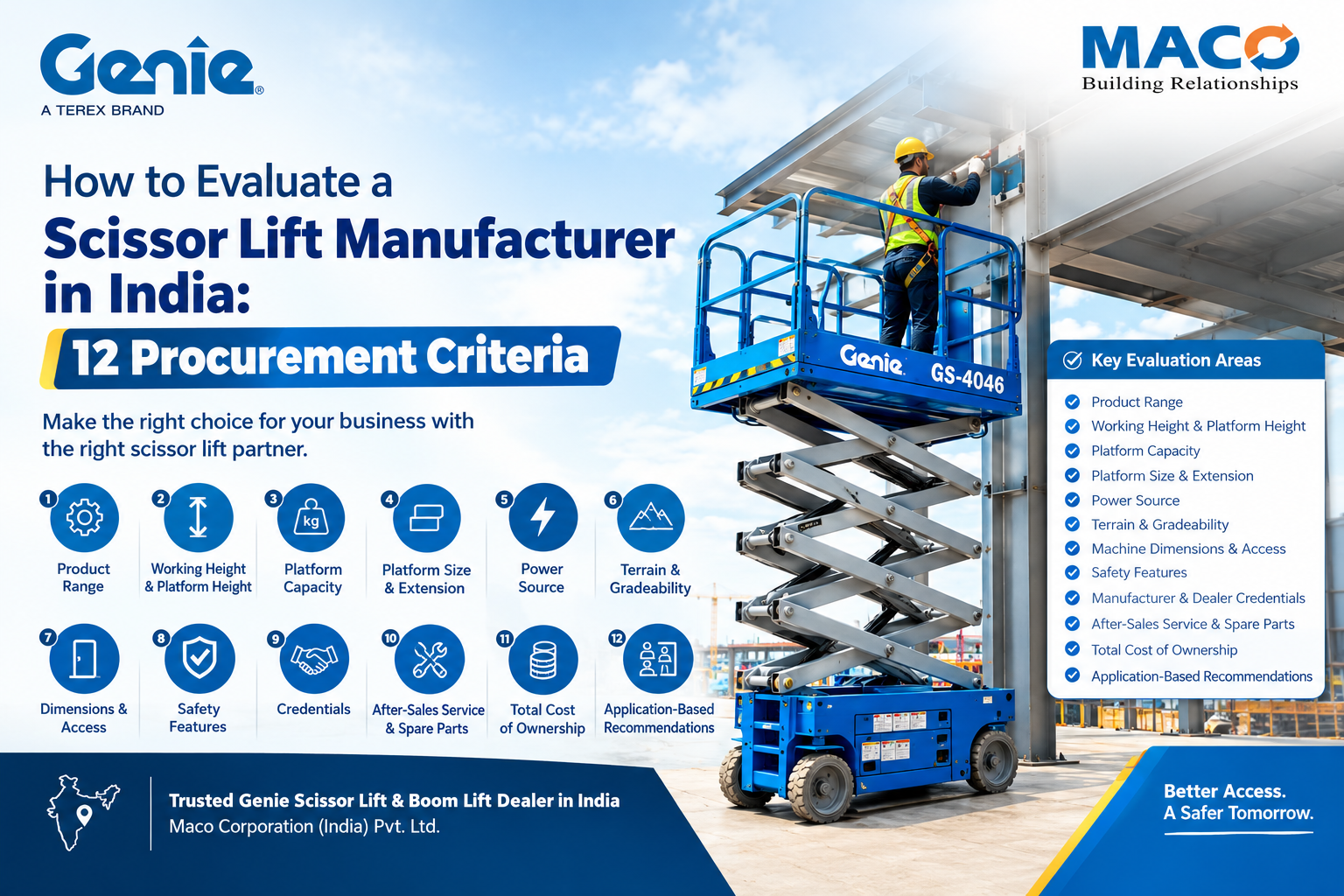
Before purchasing a scissor lift, evaluate the manufacturer or authorised dealer based on these 12 criteria:
- Scissor lift product range
- Working height and platform height
- Platform capacity
- Platform size and extension
- Power source
- Terrain and gradeability
- Machine dimensions and access requirements
- Safety features
- Manufacturer and dealer credentials
- After-sales service and spare parts
- Total cost of ownership
- Application-based equipment recommendations
These factors help procurement teams compare scissor lift manufacturers, suppliers and dealers in India based on operational requirements rather than price alone.
What Is a Scissor Lift?
A scissor lift is a type of Mobile Elevating Work Platform (MEWP) designed to raise workers, tools and materials vertically to an elevated working position. Unlike boom lifts, which can provide horizontal outreach, scissor lifts primarily provide vertical elevation with a large working platform.
Scissor lifts are commonly used for:
- Building and facility maintenance
- Electrical and mechanical installation
- Warehouses and logistics facilities
- Manufacturing plants
- Construction projects
- Infrastructure projects
- Industrial maintenance
- HVAC and MEP installation
- Indoor maintenance and fit-out work
The correct machine depends on factors such as required working height, platform capacity, terrain, available space and whether the equipment will be used indoors or outdoors.
12 Criteria for Evaluating a Scissor Lift Manufacturer in India
1. Check the Scissor Lift Product Range
A credible scissor lift manufacturer or authorised dealer should provide access to machines designed for different applications.
Depending on your requirements, the product portfolio may include:
- Electric scissor lifts
- Rough terrain scissor lifts
- Compact scissor lifts
- Indoor scissor lifts
- Outdoor scissor lifts
- Self-propelled scissor lifts
A broader product range makes it easier to select equipment based on working conditions rather than forcing one machine to fit every application.
2. Compare Working Height and Platform Height
Working height is one of the most important specifications when selecting a scissor lift.
However, procurement teams should distinguish between platform height and working height.
Working height generally represents the maximum height a worker can reach from the elevated platform. The machine should provide sufficient height for the intended task without requiring unsafe practices.
Before purchasing, determine:
- Required working height
- Required platform height
- Height of the work area
- Required safety clearance
- Whether additional reach is necessary
IPAF’s MEWP selection guidance recommends considering both the task height and the distance workers need to reach when selecting equipment.
3. Verify Platform Capacity
Platform capacity determines how much weight the machine can safely support.
Calculate the combined weight of:
Workers + tools + equipment + materials = required platform capacity
For example, if two workers are carrying tools and installation materials, their combined weight must remain within the manufacturer’s rated platform capacity.
Do not select a scissor lift based only on working height. Platform capacity is equally important for safe and productive operation.
4. Evaluate Platform Size and Extension
Platform dimensions affect productivity, particularly when multiple workers need to work simultaneously.
Consider:
- Platform length
- Platform width
- Platform extension
- Number of workers
- Tools and materials required
- Workspace available at height
A larger platform may improve productivity for installation and maintenance tasks, while a compact platform may be more suitable for restricted indoor areas.
5. Check the Power Source
The power source should match the working environment.
Electric scissor lifts are commonly suited to indoor applications where low noise and zero direct emissions are important.
Diesel or other engine-powered rough terrain machines can be suitable for demanding outdoor applications where terrain and site conditions require greater mobility.
When evaluating a supplier, ask about:
- Battery technology
- Charging requirements
- Operating hours
- Charging infrastructure
- Engine type, where applicable
- Maintenance requirements
6. Consider Terrain and Gradeability
Not every scissor lift is suitable for every worksite.
For indoor applications, smooth floors and narrow access routes may favor compact electric machines.
Outdoor construction and infrastructure sites may require rough terrain scissor lifts designed for uneven surfaces and demanding site conditions.
Evaluate:
- Indoor or outdoor operation
- Surface conditions
- Maximum gradient
- Ground clearance
- Traction
- Tire type
- Stabilization requirements
IPAF’s selection checklist specifically highlights terrain, ground conditions and site access as important factors when choosing a MEWP.
7. Check Machine Dimensions and Site Access
A machine may have the correct working height but still be unsuitable if it cannot reach the work area.
Before purchasing, measure:
- Door widths
- Gate openings
- Aisle widths
- Ceiling heights
- Loading/unloading areas
- Floor load limitations
- Transport restrictions
Also check the machine’s:
- Overall width
- Overall height
- Length
- Turning radius
- Machine weight
This is particularly important for warehouses, factories and indoor maintenance applications.
8. Evaluate Safety Features
Safety should be a core procurement criterion when evaluating a scissor lift supplier in India.
Depending on the machine model, relevant safety features may include:
- Platform guardrails
- Emergency stop systems
- Emergency lowering
- Tilt or level sensors
- Overload protection
- Drive and elevation interlocks
- Pothole protection
- Platform controls
- Alarm systems
- Ground controls
Safety equipment alone is not sufficient. Operators should also receive appropriate training, and equipment should be inspected and maintained according to applicable requirements.
9. Verify Manufacturer and Dealer Credentials
When comparing scissor lift manufacturers in India, verify the supplier’s relationship with the original equipment manufacturer.
Ask:
- Is the supplier an authorised dealer?
- What brands do they represent?
- Can they provide genuine documentation?
- Do they provide technical support?
- Are genuine spare parts available?
- Do they have trained service personnel?
An authorised channel can provide better access to manufacturer-specific technical information, parts and service support.
10. Evaluate After-Sales Service and Spare Parts
The purchase does not end when the machine is delivered.
Downtime can affect project schedules and operational productivity. Therefore, evaluate the supplier’s:
- Service network
- Preventive maintenance support
- Spare parts availability
- Technician response time
- Troubleshooting support
- Warranty terms
- Maintenance packages
For industrial buyers, after-sales support can be as important as the initial machine price.
11. Compare Total Cost of Ownership
The lowest purchase price does not necessarily mean the lowest overall cost.
Consider the Total Cost of Ownership (TCO), including:
Purchase price + transportation + energy/fuel + maintenance + spare parts + servicing + downtime
For electric scissor lifts, battery life and charging requirements should also be considered. For engine-powered machines, fuel consumption and engine maintenance can influence operating costs.
A good procurement decision should therefore compare the expected lifecycle cost of competing machines.
12. Choose a Supplier That Understands Your Application
A professional scissor lift supplier should understand the application before recommending a machine.
Share information such as:
- Required working height
- Required outreach, if applicable
- Platform capacity
- Indoor/outdoor use
- Ground conditions
- Site dimensions
- Number of operators
- Tools and materials
- Operating frequency
- Transportation requirements
IPAF’s MEWP selection guidance similarly recommends evaluating the task, environment, terrain, access restrictions, weight requirements and operator considerations before selecting equipment.
Scissor Lift Manufacturer vs Dealer: What Should Buyers Look For?
The terms manufacturer, authorised dealer and supplier are sometimes used interchangeably, but procurement teams should verify exactly who is supplying the equipment.
A manufacturer produces the machine, while an authorised dealer may represent the manufacturer in a particular market and provide sales, service, parts and technical support.
For buyers in India, an authorised distribution channel can simplify:
- Product selection
- Equipment sourcing
- Genuine spare parts
- Technical support
- Warranty coordination
- Maintenance
- Operator training
Therefore, don’t evaluate a supplier only by the machine quotation. Evaluate the complete support ecosystem.
Scissor Lift Procurement Checklist
Before finalising a purchase, ask these questions:
Machine
- What working height is required?
- What platform capacity is required?
- What platform size is suitable?
- Is an extension deck required?
Application
- Will the machine operate indoors or outdoors?
- What type of terrain will it encounter?
- What access restrictions exist?
- How frequently will it operate?
Supplier
- Is the supplier authorised?
- Are genuine spare parts available?
- What service support is provided?
- What warranty is included?
- Is operator training available?
Cost
- What is the total ownership cost?
- What are the maintenance requirements?
- What are the expected energy or fuel costs?
- What happens if the machine requires urgent service?
Conclusion
Selecting a scissor lift manufacturer in India requires more than comparing quotations. Procurement teams should evaluate working height, platform capacity, power source, terrain, machine dimensions, safety, manufacturer credentials, after-sales service and total cost of ownership.
A structured evaluation helps businesses select a scissor lift supplier or authorised dealer that can provide the right equipment for their application and support the machine throughout its operating life.
For businesses looking for Genie scissor lifts and boom lifts in India, Maco Corporation India Pvt. Ltd. provides access equipment solutions and support for a range of industrial applications. Buyers can evaluate the available Genie equipment based on working height, platform capacity, application, terrain and site requirements before making a procurement decision.
Looking for the right Genie scissor lift or boom lift for your project? Contact Maco Corporation India Pvt. Ltd. to discuss your application and equipment requirements.
Frequently Asked Questions About Scissor Lift Manufacturers in India
1. What should I consider when choosing a scissor lift manufacturer in India?
Consider product quality, working height, platform capacity, machine dimensions, application suitability, safety features, manufacturer credentials, spare parts availability, after-sales service and total cost of ownership.
2. Which type of scissor lift is best for industrial applications?
The right scissor lift depends on the application. Electric models can be suitable for many indoor industrial applications, while rough terrain scissor lifts may be more appropriate for demanding outdoor environments.
3. How do I choose the right scissor lift size?
Start with the required working height, platform capacity, platform dimensions and site access restrictions. Then consider terrain, machine width, turning radius and operating environment.
4. Is working height the same as platform height?
No. Platform height refers to the maximum elevation of the platform, while working height generally accounts for the operator’s reach from the elevated platform.
5. Why is after-sales service important when buying a scissor lift?
Reliable service and spare parts support can reduce equipment downtime and help maintain machine availability throughout its operating life.
6. Should I compare scissor lifts only by price?
No. Procurement teams should compare the complete cost of ownership, including purchase price, energy or fuel, maintenance, spare parts, servicing and potential downtime.