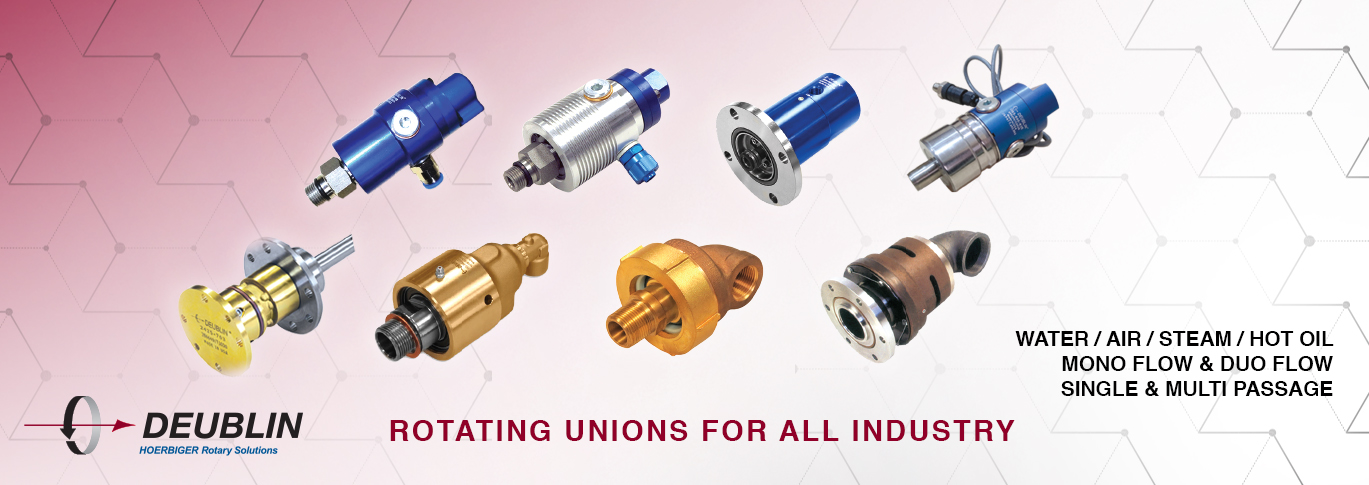
Selecting the wrong rotary union doesn’t just waste money—it causes catastrophic production failures. Premature seal deterioration, unexpected equipment breakdowns, contamination issues, and safety hazards compound into operational nightmares that manufacturers face every year. A properly specified Deublin rotary union, by contrast, delivers 10+ years of reliable service with minimal maintenance, protecting your capital investment and production schedule.
This comprehensive yet practical guide walks you through ten essential selection steps that industrial professionals use to specify optimal rotary couplings for demanding applications—from CNC machine tools to continuous casting systems, tire manufacturing to steam-powered paper machines. By systematically addressing each factor, you’ll make an informed decision that balances technical performance, operational reliability, and total cost of ownership.
Step 1: Identify Your Media Type and Chemical Compatibility
The selection process begins with a fundamental question: What fluid or gas will flow through this union? The answer determines seal materials, housing construction, bearing types, and ultimately, service life expectations.
Different media types impose radically different demands on rotary union components:
Liquid Media Selection:
Water-based coolants represent the most common application in modern manufacturing. These fluids require corrosion-resistant housing materials and strict filtration discipline—maintaining cleanliness to 40 microns maximum to protect precision-lapped seal faces. Hydraulic oils, used in clamping and actuator systems, demand petroleum-compatible seals capable of handling pressures up to 210 bar. Cutting oils and specialized MQL (Minimum Quantity Lubrication) systems require full-flow union designs that prevent chip accumulation in restricted passages.
High-temperature applications using hot oil or thermal transfer fluids present special challenges. When media temperatures exceed 160°C, standard bearing lubricants degrade, requiring either high-temperature grease or complete redesign using pressure-type seals without ball bearings. Steam applications demand entirely different seal technology—pressure-type designs featuring carbon graphite seals rated to 320°C+, specifically engineered for paper machines, corrugating equipment, and textile processing.
Gaseous Media Considerations:
Compressed air applications typically operate at lower pressures (10 bar) and require unions capable of unlimited dry-run operation without seal damage. Vacuum service demands sealed designs that prevent atmospheric air ingress while the system operates under negative pressure.
Before contacting Maco Corporation for specifications, gather your fluid’s technical datasheet documenting chemical composition, operating temperature range, viscosity rating, and contamination levels. This single document prevents costly specification errors and ensures first-time accuracy.
Step 2: Determine Maximum Operating Pressure Requirements
Operating pressure represents one of the most critical specification parameters, yet engineers frequently underestimate it by specifying for average operating conditions rather than peak system pressure including pressure spikes.
Pressure Rating Categories and Applications:
Low-pressure applications (0-10 bar) handle compressed air and low-pressure water service using simple, economical designs. Medium-pressure systems (10-70 bar) cover standard CNC coolant delivery and general hydraulic applications, typically specified with the 1005 Series reaching 105 bar maximum. High-pressure service (70-140 bar) demands heavy-duty designs like the 1109 Series rated to 140 bar, commonly used for high-pressure coolant (HPC) machining and hydraulic clamping. Extra-high-pressure applications (140-210 bar) require reinforced designs such as the 1121 Series, used in hard milling operations and extreme-pressure through-spindle coolant delivery.
The Pressure Spike Rule:
Never specify for normal operating pressure alone. Account for transient spikes during system startup, pressure surges from rapid valve closure, or relief valve setpoints. If your system can generate 140 bar under any circumstance—even briefly—specify a union rated for at least 140 bar, regardless of average 100 bar operating conditions.
Why Balanced Mechanical Seals Matter:
Deublin’s revolutionary balanced mechanical seal technology, introduced in 1945, fundamentally changed rotary union performance. This design exposes portions of both seal faces to line pressure, creating opposing hydraulic forces that dramatically reduce effective contact pressure. At identical system pressure, a balanced seal experiences only 65 psi effective contact pressure while conventional pressure-type seals experience 500 psi—nearly eight times higher. This 85% pressure reduction translates directly to extended seal life and reduced maintenance costs over the union’s operational lifetime.
Step 3: Specify Rotational Speed (RPM) Capabilities
Rotational speed has profound effects on seal wear rates, bearing life, and heat generation. The relationship between speed and seal technology is non-negotiable—mismatching these parameters guarantees premature failure.
Speed-Matched Seal Technology Selection:
Low-speed applications (0-300 RPM) utilize cost-effective soft seal designs using elastomeric or PTFE materials that deform to create sealing contact. These simple seals tolerate minor misalignment but cannot withstand high friction-induced heat at elevated speeds.
Medium-speed ranges (300-10,000 RPM) represent the sweet spot for standard mechanical seal designs. Balanced mechanical seals perform optimally in this range, with series like 1005 (up to 15,000 rpm), 1101, and 1109 (up to 20,000 rpm) delivering exceptional service life.
High-speed applications (10,000-36,000 RPM) demand precision-lapped balanced mechanical seals combined with angular contact ball bearings in X-arrangement configuration. The bearing geometry becomes critical—X-arrangement bearings handle radial and thrust loads simultaneously, essential for speeds where centrifugal forces become significant. Series 1116 reaches 24,000 RPM safely.
Extra-high-speed service (36,000+ RPM) requires ultra-precision designs with specialized bearing configurations and friction-minimized seal faces. The 902 Series with special angular contact bearings handles speeds exceeding 50,000 RPM, used in aerospace grinding spindles and high-speed dental tooling.
Step 4: Calculate Flow Rate and Select Port Size
Adequate flow capacity directly determines tool performance, cooling effectiveness, and system efficiency. Undersized unions create excessive pressure drop, reducing pressure at the actual working point and degrading performance.
Port Sizing Guidelines:
Port selection follows fluid mechanics principles where flow area determines pressure drop. The 1/4-inch (6mm) port handles up to 20 liters per minute, suitable for small machine tool applications and pneumatic service. The 3/8-inch (10mm) port, the most common in standard CNC machining centers, delivers approximately 40 liters per minute. 1/2-inch (12mm) ports support 60 liters per minute for large boring mills and heavy-duty applications. 3/4-inch (20mm) ports provide 100+ liters per minute for high-flow cooling systems and hydraulic applications, while 1-inch and larger ports exceed 150 liters per minute for large-scale industrial hydraulics.
Thread Type Standardization:
Connection threads significantly impact installation and fluid coupling reliability. NPT (National Pipe Thread) uses tapered threads common in North America. BSP/BSPP (British Standard Pipe) employs parallel threads with sealing washers, typical in European equipment. Metric threads (M14, M16, M22) appear increasingly in modern machinery, particularly Asian-manufactured equipment. Verify thread type early in the specification process to avoid costly installation delays.
Deublin’s Full-Flow Advantage:
Deublin’s full-flow rotary unions feature internal passages sized to match external port diameters with no restrictions or sharp transitions. This engineering approach prevents chip accumulation (critical in coolant applications) and minimizes pressure loss—essential for maintaining tool performance in hard milling and other demanding operations.
Step 5: Assess Operating Temperature Range
Temperature extremes challenge every component in a rotary union—seal materials, bearing lubricants, housing metals, and elastomeric elements all have specific temperature limits beyond which performance rapidly degrades.
Temperature-Specific Material Selection:
Standard operating range (-10°C to 71°C) accommodates most coolant, air, and hydraulic oil applications using conventional NBR (nitrile) seals and grease-lubricated ball bearings. This covers the majority of machine tool installations worldwide.
Elevated temperature service (71°C to 180°C) introduces material constraints. Standard elastomers begin losing flexibility; ball bearing grease approaches viscosity limits. PTFE (polytetrafluoroethylene) and specialty high-temperature elastomers become necessary, sometimes combined with high-temperature grease or oil-lubricated bearing designs.
High-temperature applications (180°C to 320°C+) are fundamentally incompatible with standard rotary union designs. Ball bearing grease completely breaks down above 160°C, causing bearing seizure and immediate failure. These applications—steam-powered equipment, hot oil circulation systems, thermal fluid heat transfer—absolutely require pressure-type seal designs featuring NO ball bearings, utilizing instead carbon graphite or tungsten carbide seal faces capable of withstanding extreme temperatures.
Critical Selection Rule:
Steam and hot oil applications cannot use standard bearing-supported unions—this is non-negotiable engineering reality. Deublin’s Type C Steam Rotary Joints and specialized hot oil unions eliminate ball bearings entirely, using pressure-type seals optimized for extreme temperature service.
Step 6: Select Bearing Type and Mounting Configuration
The bearing system determines installation difficulty, maintenance requirements, speed capability, and service life. This choice profoundly impacts your long-term ownership experience.
Bearing-Supported Design (Most Common)
Bearing-supported rotary unions feature integrated ball bearings within the housing, enabling self-support without precision spindle requirements. Installation is straightforward—thread onto spindle, connect hoses, and operate. This design tolerates minor spindle runout and misalignment, forgiving installation imperfections that would damage bearingless designs. Field replacement requires no special equipment or spindle preparation.
Disadvantages include bearing maintenance requirements (periodic lubrication intervals), RPM limitations imposed by bearing grease temperature limits, larger physical envelope requirements, and an additional failure mode if bearings aren’t properly maintained.
Series 1005, 1101, 1109, 1116, and 902 represent the standard bearing-supported product line, covering approximately 90% of machine tool applications.
Bearingless (Bore-Mounted) Design
Bearingless unions eliminate the bearing support structure entirely, achieving minimal axial and radial dimensions. Without bearing grease temperature limitations, these designs handle significantly higher rotational speeds than bearing-supported equivalents while potentially extending service life by eliminating a wearing component.
However, bearingless designs demand precision spindle preparation—spindle bore must be precision-ground to tight tolerances. Installation requires exact alignment and press-fitting, necessitating specialized equipment and expertise. Zero misalignment tolerance means any spindle runout transfers directly to the union’s seal faces, creating premature failure risk.
Series 1117 and 1139 represent the bearingless offering, optimal for space-constrained applications and high-speed spindles where precision machining support is available.
Step 7: Choose Optimal Seal Technology
Seal technology represents the heart of any rotary union specification. The seal technology choice determines 80% of performance and service life characteristics, making this decision critical to overall system success.
Balanced Mechanical Seals (Closed Seal Design)
Deublin’s legendary balanced mechanical seal delivers unmatched longevity—10 to 20 times longer than conventional pressure-type designs. Micro-lapped seal faces (precision ground to 2 light bands flatness) ensure minimal leakage while the balanced design handles pressures up to 210 bar and speeds to 50,000 RPM. Low friction characteristics produce minimal heat generation and torque requirements.
Best suited for continuous coolant delivery, high-pressure coolant (HPC) systems, MQL (Minimum Quantity Lubrication) applications, and any scenario with uninterrupted media flow during rotation. Series 1005, 1101, 1108, and 1116 feature this technology.
Pop-Off Seals (Dry-Run Capable)
Pop-Off technology delivers game-changing capability for applications with intermittent coolant delivery or frequent dry rotation periods. Spring-loaded seals automatically separate when media flow ceases, allowing unlimited rotation without seal face contact—eliminating wear during non-productive rotation. When media reintroduces, springs close the seals for leak-tight transfer. Small drain ports manage minimal leakage during operation.
This technology revolutionizes transfer line tooling, machine tools with frequent tool changes, and indexing applications where production equipment rotates without active coolant flow. However, Pop-Off designs require drain lines for controlled leakage collection, with the drain port positioned at 6 o’clock and sloping continuously downward.
Series 902, 1109, and 1111 incorporate Pop-Off technology.
Pressure-Type Seals (High-Temperature Service)
Pressure-type seal designs operate up to 320°C+ without ball bearings, achieving robust simplicity in extreme-temperature environments. Carbon graphite and tungsten carbide seal faces withstand harsh thermal conditions where no other design survives.
Trade-offs include high seal face contact pressure (9 times greater than balanced seals at identical line pressure), limited speed capability (typically under 500 RPM), higher torque requirements, and shorter operational life due to increased friction. These limitations are acceptable—even desirable—in steam and hot oil service where temperature overrides all other considerations.
Step 8: Consider Environmental Operating Conditions
Manufacturing environments vary dramatically in cleanliness, temperature stability, humidity, and corrosiveness. These environmental factors determine housing materials, seal protection features, and maintenance intervals.
Temperature Management and Thermal Cycling:
Cold environments (below 0°C) require elastomer compounds rated for low-temperature flexibility, along with humidity management to prevent condensation. Hot environments (above 40°C) accelerate elastomer aging and may necessitate upgraded seal materials. Thermal cycling—frequent temperature swings—creates expansion/contraction stress cycles that potentially introduce moisture ingress and seal face separation.
Installation Orientation and Gravity Drainage (Non-Negotiable):
In horizontal installations, the drain port MUST position at 6 o’clock (bottom-dead-center) with the drain line maintaining at least a 15-degree downward slope throughout its length. This gravity-dependent drainage is non-optional—pooled condensate in bearing cavities guarantees failure, destroying bearing lubrication and causing rust formation that leads to bearing seizure and seal damage. Verify drainage slope during installation using a level or inclinometer.
Contamination and Corrosion Protection:
Clean environments need standard sealing protection. Normal industrial settings benefit from effective labyrinth seals with regular cleaning. Harsh environments (foundries, offshore installations) demand sealed bearings and stainless steel materials. Marine/coastal locations absolutely require stainless steel housings to resist salt spray corrosion.
Step 9: Evaluate Maintenance Requirements and Service Life
Total cost of ownership extends far beyond initial purchase price. Maintenance accessibility, spare parts availability, service life expectations, and repair options significantly impact long-term economics.
Realistic Service Life Expectations:
Deublin’s balanced mechanical seals typically deliver 10,000 to 50,000+ operating hours—often 5-10 years in normal manufacturing service. Properly maintained installations operate 10+ years without seal replacement. These extraordinary intervals contrast dramatically with conventional designs.
Maintenance Accessibility and Spare Parts:
Deublin maintains 50+ global dealers providing 24-48 hour parts delivery. Complete seal replacement kits are available for current and legacy models. Factory reconditioning—complete disassembly, cleaning, component replacement, precision testing, and 12-month warranty—costs 30-50% of new unit price with 1-2 week turnaround.
Step 10: Match Specifications to the Right Deublin Series
After systematically evaluating all parameters, match your requirements to the optimal series:
Standard Machine Tool Applications:
• 1005 Series: Continuous coolant, ≤105 bar, ≤15,000 RPM—CNC centers, boring mills
• 1101 Series: Compact, ≤105 bar, ≤10,000 RPM—transfer lines, multi-spindle machines
High-Performance Requirements:
• 1109 Series: Pop-Off seals, ≤140 bar, ≤20,000 RPM—through-spindle coolant, hard milling
• 1121 Series: Ultra-high-pressure, ≤210 bar—extreme hard milling
Speed and Multi-Media:
• 1116 Series: Up to 24,000 RPM—grinding, high-speed milling
• 902 Series: Exceeds 36,000 RPM—aerospace machining
• 1114 Series: AutoSense multi-media—rotary index tables
Industrial Applications:
• Type C Steam Unions: 320°C capable—paper machines, corrugating
• Multi-Passage Series: Complex clamping systems, automated centers
Conclusion: Make Your Rotary Union Selection with Complete Confidence
You now possess the comprehensive knowledge that industrial engineers and manufacturing professionals use to specify optimal Deublin rotary unions for mission-critical applications. By systematically working through these ten selection steps—from media type identification through environmental operating conditions—you ensure your final choice delivers reliable performance, extended service life, and minimal unplanned downtime.
The key to successful rotary union selection is precision in specification. Small details matter: proper pressure rating prevents seal failure, correct RPM selection ensures bearing longevity, adequate flow capacity maintains tool performance, and correct bearing type determines maintenance requirements. Environmental considerations and maintenance accessibility directly impact total cost of ownership over the equipment’s lifetime.
Deublin’s 75+ years of manufacturing excellence, combined with our micro-lapped seal face precision and balanced mechanical seal technology, delivers industry-leading service life and reliability. When specified correctly and installed properly, a Deublin rotary union operates 10+ years with minimal maintenance—a dramatic advantage over conventional alternatives requiring frequent seal replacement.
This investment in precision specification pays dividends through:
- 10-20x longer seal life compared to pressure-type designs
- Minimal maintenance requirements reducing labor costs
- Reduced unplanned downtime protecting production schedules
- Lower total cost of ownership despite higher initial investment
- Proven reliability across millions of global installations
Whether you’re operating CNC machining centers, transfer lines, steam-powered paper machines, or specialized industrial equipment, Maco Corporation’s technical team stands ready to ensure you receive exactly the right rotary union specification on the first try.
Frequently Asked Questions
Q1: What’s the Difference Between 1005 and 1109 Series Rotary Unions?
The 1005 Series features a closed seal design for continuous coolant flow (105 bar max, 15,000 RPM), while the 1109 Series incorporates Pop-Off seals allowing unlimited dry rotation (140 bar max, 20,000 RPM). Choose 1005 for continuous coolant applications like standard CNC centers. Specify 1109 for transfer lines or equipment with frequent dry rotation periods—the Pop-Off® technology eliminates seal wear during non-productive rotation, extending service life from 2-3 years to 5-7 years.
Q2: Should I Select Bearing-Supported or Bearingless Design?
Bearing-supported designs (1005, 1101, 1109, 1116, 902 series) represent 90% of machine tool installations. They’re straightforward to install, tolerate minor misalignment, and don’t require precision spindle preparation. Bearingless designs (1117, 1139 series) offer minimal dimensions and handle speeds exceeding 24,000 RPM, but demand precision spindle bore grinding and exact alignment. Select bearing-supported for standard machines; choose bearingless only when space is critical or spindle speeds exceed 24,000 RPM with precision machining support available.
Q3: What Causes Premature Rotary Union Failure?
The three leading failure causes are inadequate coolant filtration (40% of failures), spindle misalignment/runout exceeding 0.02mm TIR (35% of failures), and operating beyond pressure or RPM ratings (25% of failures). Prevent failure by maintaining 40-micron maximum filtration, verifying spindle runout <0.02mm with a dial indicator before installation, and always specifying for maximum possible system pressure including pressure relief valve setpoint.
Q4: How Often Should I Replace Rotary Union Seals?
Deublin balanced mechanical seals typically last 10,000-50,000+ operating hours (5-10 years normal service). Replace seals when observing consistent external leakage beyond normal weepage, visible seal face damage, or noticeably increased torque requirements. A properly filtered, correctly installed 1005 Series union with 10,000 operating hours costs ~$1,200 total (initial $800 + seal kit $400) versus competitor unions requiring replacement every 3,000 hours—delivering lower total cost of ownership despite higher initial investment.
Q5: Can I Use One Rotary Union for Multiple Media Types?
Standard single-media rotary unions cannot safely handle multiple media types due to cross-contamination risk. However, Deublin’s AutoSense technology (1114 and 1154 series) automatically detects whether coolant, compressed air, or vacuum is present and optimizes seal behavior accordingly. AutoSense eliminates cross-contamination, reduces manifold complexity, simplifies machine design, and is particularly valuable for rotary index tables requiring simultaneous coolant and pneumatic clamping.
Contact Maco Corporation, India’s sole authorized Deublin distributor for 30+ years:
Phone: 1800 890 6226 | Email: info@macocorporation.com | Website: www.macocorporation.com
Our technical team ensures you receive the optimal rotary union specification on the first try—avoiding costly mistakes and delivering reliable, long-term performance.